.png)
Opinion: Empty Schoolyards, Missing Parks: Phnom Penh’s Overlooked Opportunity

By Norak Prak
Junior Research Fellow
Future Forum's young research fellow, Norak Prak was published in Cambodianess on April 16th, 2026. Check out the original article HERE, and read it below!

Phnom Penh doesn’t just need bigger parks—it needs closer ones. Because a public space only works if people can actually reach it, and right now, too many can’t.
In Phnom Penh, access to public space remains one of the city’s quiet but persistent challenges. To be fair, there has been real progress. The riverside pedestrian zone, with its temporary traffic closures, has turned into a lively weekend draw. And plans for a new central park on the former Pochentong Airport site signal a welcome shift—one that echoes how many post-war European cities transformed disused land into green, shared spaces.
But here’s the catch: bigger isn’t always better.
Large, centralized parks can unintentionally create new problems. They pull people in from across the city, often by motorbike or car, adding to congestion and pollution, something we already see with Walk Street. For residents living on the outskirts, getting there can be a hassle, if not a barrier. And once built, these large parks demand significant maintenance, which raises questions about long-term sustainability.
More importantly, central parks don’t serve everyone equally. Older people, young children, and people with disabilities often rely on proximity. If a park is not within walking distance, it is essentially nonexistent. Accessibility isn’t just about design—it’s about location.
For those with private transport, distance may not feel like a big issue. But for many others, especially lower-income families, having a small green space nearby can make a real difference.
This is where “pocket parks” come in—small, decentralized public spaces woven into neighborhoods, where people can gather, relax, and build a sense of community without needing to travel far.
Of course, Phnom Penh faces a real constraint: land. Open, unused space is limited, and urban development pressures are intense. But the city isn’t without options. One underused resource is already embedded in communities across the capital: schools.
Ideal Space for Public Use
The public schools in Phnom Penh usually have readily available green and open spaces. Schools have also already dispersed throughout the city, making them accessible to communities outside the city.
Using public schools as public spaces is advantageous due to both the amenities and the available usage time. With the school day usually ending at 5PM and Sundays free, this creates a time slot for the community members to use.
A report on public space in Phnom Penh found that most people tend to use these areas in the evening—either after work or to avoid the daytime heat—making school operating hours a natural fit. The same report also noted that people primarily use public spaces to relax, exercise, and spend time with others, which closely mirrors how school grounds are already used.
For example, many public schools are equipped with sports facilities, including spaces for volleyball and soccer, making them well-suited to serve as shared community spaces beyond school hours.
Presently, this practice can be seen in several notable high schools in Phnom Penh, including Baktouk High School and Sisowath High School, where basketball tournaments are regularly held. However, schools in smaller communities should also expand this approach.
Operating A Public Space
Currently, many schools are closed to the public after 5 p.m., which means large spaces sit unused for most of the day—an inefficient use of valuable urban land.
The most immediate and resource-efficient step would be for city authorities to formally recognize public schools in Phnom Penh as shared public spaces through clear policies and announcements. From there, access can be structured and predictable, with designated hours—for example, after 5 p.m., on Sundays, or during public holidays when classes are not in session.
A more ambitious shift would involve rethinking how schools are physically designed. Many campuses are surrounded by blank perimeter walls, often referred to as “dead walls," which studies have linked to higher risks of crime and vandalism. These walls primarily serve to keep students from leaving and to block noise, but they also create unwelcoming, inactive street edges.
Replacing them with transparent fencing could make school grounds feel more open and visible while improving safety by allowing natural surveillance from the street. At the same time, trees and greenery could help buffer traffic noise, offering a more pleasant and community-friendly alternative.
Furthermore, once the public space is established, the community could start their own events and projects, including gardening, fairs, or even sport tournaments. Major events could be booked with the public space administration and displayed on a community event board, while smaller gatherings for students or community members can be done without approval.
It is important for the school to designate the spaces that do not need to be reserved for events and other spaces that can be used for larger community events. Students could join in to create a ‘community space map’ that informs the community of these designations.
A good example of such activity is gardening. Some primary schools in Phnom Penh still have gardening activities, planting fruits and vegetables. When initiated in communities that are financially vulnerable, the school gardens could provide food for the community and act as a food education program for young students.
In terms of maintenance, public schools already have systems in place. Students routinely clean their classrooms and school grounds, while groundskeepers handle heavier maintenance tasks. This makes it far more cost-effective than building and maintaining entirely new public spaces, which would require additional resources for cleaning, landscaping, and upkeep.
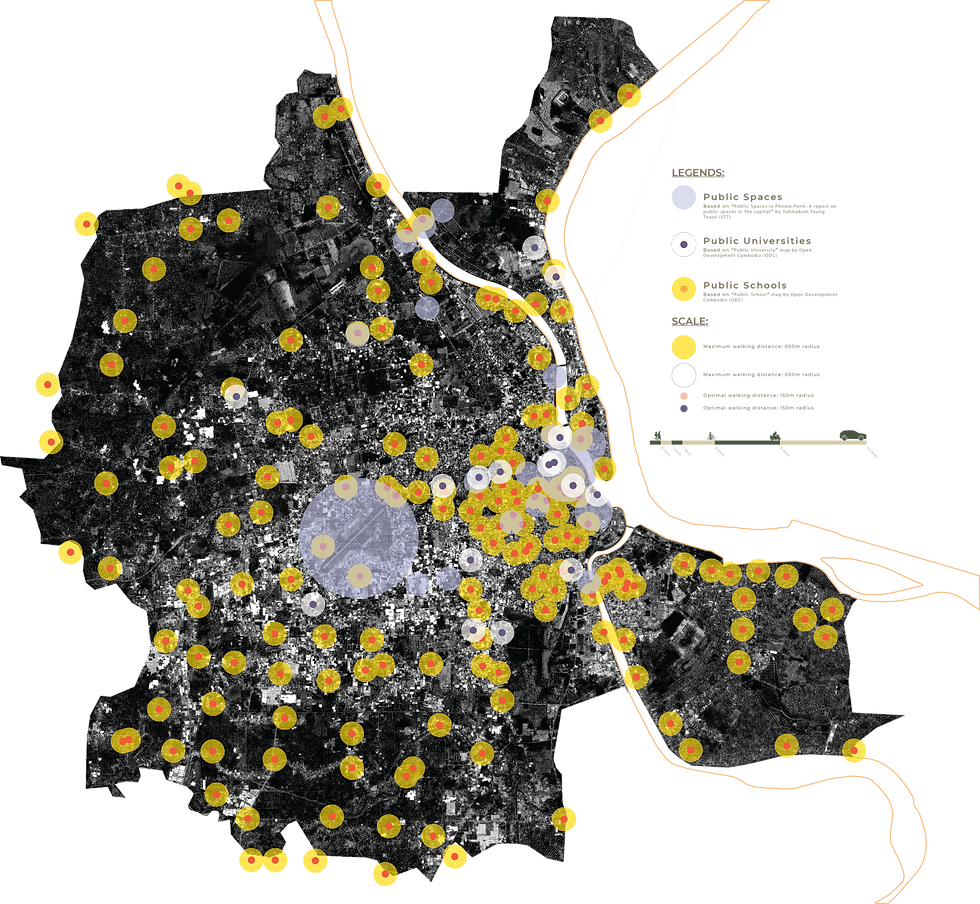
There’s also a strong chance the surrounding community would pitch in. Schools could organize volunteer clean-up days during holidays, and for smaller schools, basic equipment like brooms could be made available so visitors can tidy up after themselves. This kind of shared responsibility isn’t unusual—many municipalities in Japan, for example, rely on community members, including the elderly, to help maintain local green spaces when funding is limited.
The balance between formal and informal use will naturally vary from one school to another, depending on factors like size and distance from the urban core. With the right approach, these spaces can shift fluidly between school functions and community use. Smaller schools, in particular, may be easier to adapt, given their more flexible environments and the typically close relationships between school administrators, parents, and local youth.
Conclusion
Creating new public spaces in Phnom Penh is always welcome, but it’s just as important to decentralize them—spreading them across the city so people outside the urban core can benefit as well. By building on the existing infrastructure of public schools and taking advantage of their widespread locations, Phnom Penh could create a network of “pocket parks” without requiring significant additional resources.
More importantly, elderly residents and children living nearby would gain easy access to these spaces, allowing them to socialize and connect with their communities simply by walking or cycling there.
Comments