.png)
Breaking Administrative Bottlenecks Through Direct Digital Basic Income

IPF
Future Forum's junior research fellow, Neth Chanmonyneath was published in The Cambodianess on March 28th, 2026. Check out the original article HERE, and read it below!
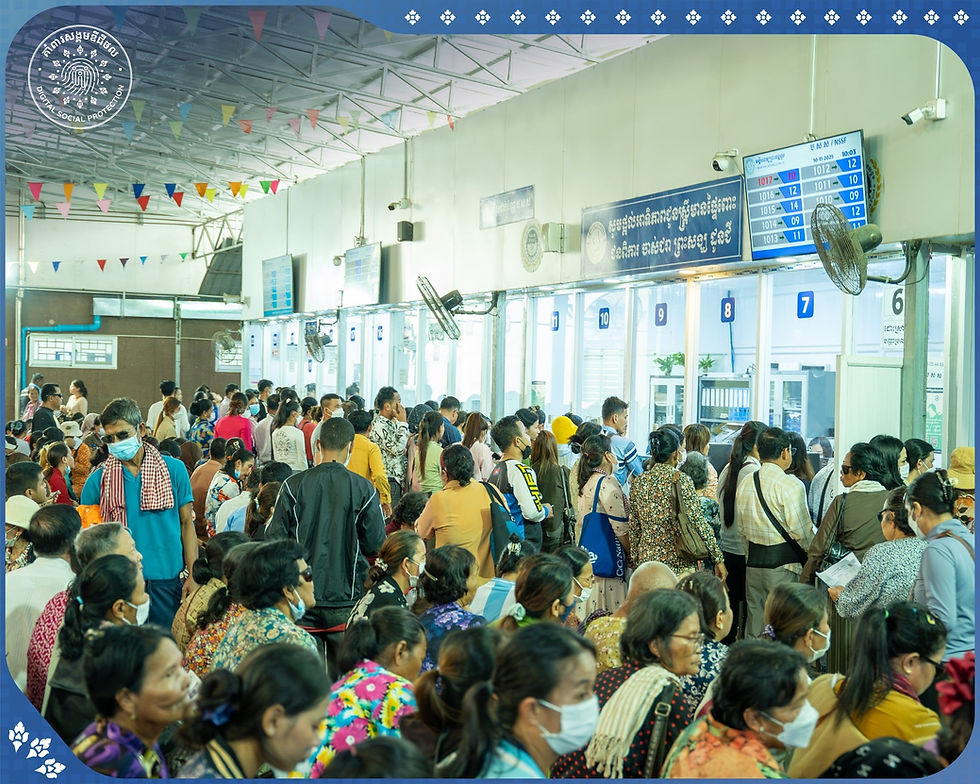
Cambodia’s push to digitize its social protection system has earned international praise—but behind the dashboards and databases, a harder question remains: can technology alone make support faster, fairer, and easier to access for those who need it most?
Cambodia’s “Global Recognition Award” for digital transformation in social protection signals real momentum toward a more inclusive digital public infrastructure. At its best, this shift is about more than technology—it’s about improving how the state reaches people. The expansion of the IDPoor program captures that ambition, moving from a traditional identification system to a more integrated, digital data registry.
But digitalization, on its own, doesn’t fix how systems work. Even as databases improve and payments become more streamlined, Cambodia’s social protection framework still leans on enrolment processes and eligibility rules that are expensive, time-consuming, and difficult to navigate. Much of this comes down to how the system is run. Decision-making remains centralized, with ministries driving implementation from the top. Meanwhile, local authorities—those closest to vulnerable households—have limited room to adjust procedures, update beneficiary data, or respond to emerging gaps
The result is a system that looks modern on the surface but struggles in practice. Administrative bottlenecks persist, making it difficult to scale up something like direct cash transfers under a Universal Basic Income (UBI) model.
This commentary focuses on those friction points. The IDPoor system, while essential, is weighed down by its own complexity—especially through targeting methods like proxy means testing, which are slow to update, costly to run, and difficult to expand. In areas already identified as vulnerable, there is a strong case for simplifying the approach altogether. Replacing complex targeting with a straightforward, unconditional basic income—delivered digitally—would cut through administrative delays and get support to people more quickly and reliably.
A Streamlined Policy Solution
The implementation of UBI relies on administrative simplicity and accessibility to function effectively. Complex bureaucratic procedures and eligibility checks slow the transfer process, leading to delays, the exclusion of vulnerable households, and a lack of timely support.
By leveraging international examples and models, Cambodia can create a cost-effective Universal Basic Income registry that efficiently delivers unconditional basic income to vulnerable groups at scale. This can be achieved by employing geographic eligibility rather than complex poverty targeting, coupled with digitally assisted or self-registration, and automated payments.
The UBI registry should employ simplified eligibility criteria and register low-income individuals using existing large national databases (National ID, census data, and IDPoor database). Eligibility for this scheme can be based on simple geographical and occupational criteria, specifically: possession of a valid national ID, residence in a designated poor geographic area or district (for example, low-income districts in Phnom Penh), and engagement in targeted occupations such as street vending, construction day labor, or working as a motorcycle or tuk-tuk driver.
This approach would also increase reach and accessibility for vulnerable populations, including women in the informal sector.
Given Cambodia’s current e-payment infrastructure, cash can be transferred directly to beneficiaries’ bank accounts, mobile wallets, or digital wallets.
Cambodia should leverage direct digital enrollment linked to verified digital bank accounts, such as Bakong Wallet / mobile payment infrastructure. This approach will bypass labor-intensive verification steps, reduce paperwork, and ensure that the cash transfers reach targeted beneficiaries quickly and directly, without the need for repeated documentation, long queues, and unnecessary travel to commune offices.
Local authorities at the sub-national level will be able to obtain flexibility to update beneficiary information in real time, ensuring that newly eligible households are included and that systematic errors are corrected. Over time, with this simplified approach, the system would create a transparent mechanism for disbursing cash transfers, improving accountability and public trust toward citizen-centered social protection systems.
Cambodia could adopt UBI delivery models based on successful examples in Kenya and South Korea. Kenya integrated digital ID, mobile payments, data systems, and agent networks to deliver services directly to poor, remote households.
The Inua Jamii Program uses a national digital ID with the mobile money platform M-Pesa. Beneficiaries are identified and verified using national ID and social registry data, and payments are made directly to bank accounts. This system enables transparent, lower-cost, and targeted cash transfers. Communities in Kenya’s UBI pilot saw economic expansion, including more enterprises and higher revenues, expenditures, and net income. Much of the growth was concentrated in non-agricultural sectors, reflecting local economic transformation.
Likewise, South Korea uses an automated bank transfer system for its Universal Basic Income model, building on initial COVID-19 emergency relief to implement a rural basic income project.
This approach leverages the country's robust digital identity system and integrated government databases to deliver cash directly to vulnerable beneficiaries, reducing bureaucratic enrollment and the risk of corruption. Counties with declining populations receive unconditional cash transfers for all residents to boost consumption and address issues such as automation's economic impact, income inequality, and regional decline amid demographic challenges.
Gyeonggi Province has already piloted UBI with local currency for youth and rural residents. Evidence suggests UBI may support labor participation, as observed effects include encouraging unemployed individuals to enter the workforce without creating substantial disincentives for employment.
Strengthening Transparency and Accountability
The government should issue a sub-decree to authorize a digital UBI pilot in Phnom Penh or other selected districts. Pilot results would lay the groundwork for a national rollout that would require a law mandating UBI as a right, defining eligibility, beneficiaries, payment terms, and mechanisms for regular, unconditional cash transfers.
To ensure transparency and accountability, the scheme requires robust legal mechanisms, including fraud prevention, monitoring, and systems for beneficiaries to file grievances or appeals. Based on this, the two key recommendations are:
First, to avoid elite capture and favoritism in beneficiary selection, adopt a legal clause requiring transparent, rule-based eligibility criteria. Publicly disclose eligibility rules, selection procedures, and the list of selected beneficiaries. Require independent verification and audits of all selection processes. These steps ensure that program benefits are allocated efficiently based strictly on socio-economic criteria, excluding personal or political objectives.
Second, beneficiaries must be able to report issues easily through decentralized channels. These include online portals, local government commune offices, and mobile reporting systems.
This can be done in two ways: anonymous reporting and community-level complaints desks, where beneficiaries’ concerns are encouraged to speak up. Anonymous reporting mechanisms should allow beneficiaries to report issues related to fraud, exclusion, or any misconduct without fear of retaliation.
For safety reasons, the designated form should not require beneficiaries to provide their personal identification information. As for community-level complaints, commune officers should hold monthly meetings with all beneficiaries, providing a space for them to voice their concerns and seek additional clarification on the program’s eligibility criteria.
Complaints should be recorded accurately and comprehensively in a clear centralized system for clear investigation and executed with clear timelines and procedures.
The key policy issue is not whether Cambodia can digitalize welfare, but whether it can simplify the system enough for a basic income. Digital basic income signals a move from bureaucracy to agile, transparent, citizen-centered support. With phased pilots, legal protection, and solid digital tools, Cambodia can take a big step toward universal basic security for its poor population.
Comments